.png)
Why VRFB Technology Is Gaining Attention for Long-Duration Energy Storage

As renewable energy adoption continues to grow, the need for reliable and long-duration energy storage has become increasingly important. Solar and wind power generate electricity when natural conditions are favourable, but electricity demand does not always match generation. This has increased interest in energy storage technologies that can store electricity efficiently and deliver it when needed.
Among the available solutions, VRFB technology (Vanadium Redox Flow Battery technology) is gaining attention for its ability to provide long-duration energy storage, support renewable energy integration, and deliver consistent performance over thousands of charge and discharge cycles. Unlike conventional battery technologies that gradually lose storage capacity over time, VRFB systems are designed for applications that require frequent cycling, long operational life, and scalable energy storage.
This article explains why VRFB technology is becoming an important part of modern energy infrastructure and where it is being used to support the transition to cleaner and more reliable electricity systems.
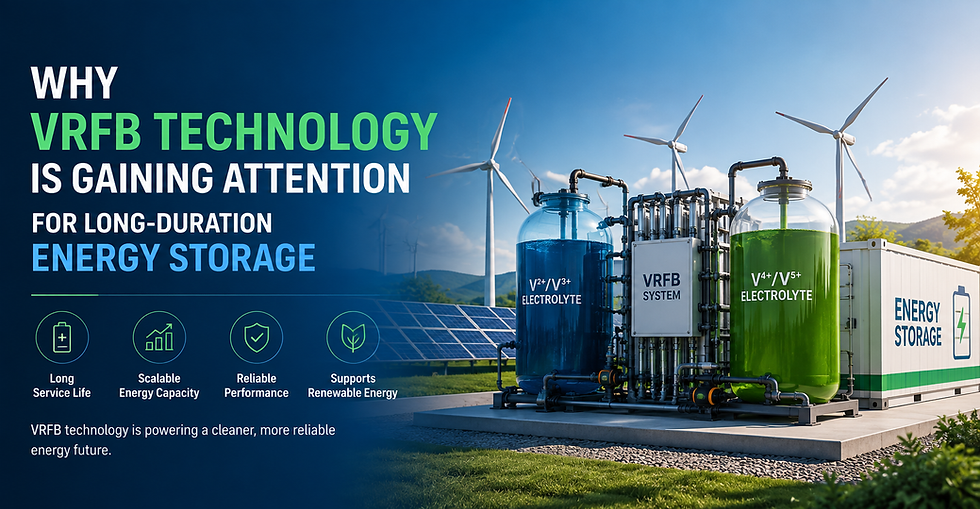
What Is VRFB Technology?
VRFB technology, short for Vanadium Redox Flow Battery technology, is a type of flow battery designed for long-duration energy storage. Instead of storing energy inside solid battery cells, it stores energy in liquid vanadium electrolyte solutions that circulate through electrochemical cells during charging and discharging.
This unique design allows the battery's power output and energy storage capacity to be scaled independently, making VRFB technology well suited for applications that require reliable energy storage over several hours. As a result, it is increasingly being used alongside renewable energy systems, Battery Energy Storage Systems (BESS), and grid-scale energy storage projects.
For readers who want to understand the technology in more detail, including how it works and its key components, our Vanadium Redox Flow Battery (VRFB) guide provides a comprehensive explanation.
Why Is VRFB Technology Gaining Attention?
As the demand for long-duration energy storage grows, organisations are looking for battery technologies that deliver reliable performance over many years while supporting renewable energy integration. VRFB technology has gained attention because it addresses several of the limitations associated with conventional battery storage, particularly in large-scale and high-cycle applications.
Long Service Life
VRFB technology is designed for long operational life with minimal capacity degradation over thousands of charge and discharge cycles. This makes it well suited for applications that require frequent daily cycling over many years.
Scalable Energy Storage
Unlike many battery technologies, the energy storage capacity of a Vanadium Redox Flow Battery can be increased by expanding the electrolyte storage tanks without significantly changing the power conversion system. This flexibility makes VRFB technology suitable for projects with varying energy storage requirements.
Reliable Performance for Long-Duration Storage
VRFB technology is capable of delivering electricity over extended discharge periods, making it a practical solution for storing renewable energy and supplying power when solar or wind generation is low.
Support for Renewable Energy Integration
By storing excess electricity generated from renewable energy sources and releasing it when demand increases, VRFB technology helps improve grid stability and enables greater use of clean energy.
Where Is VRFB Technology Used?
As energy storage requirements continue to grow, VRFB technology is being adopted across a range of commercial, industrial, and utility-scale applications. Its long service life, scalable design, and ability to deliver electricity over extended periods make it well suited for projects that require reliable long-duration energy storage.
Renewable Energy Projects
VRFB technology stores excess electricity generated by solar and wind farms and releases it when renewable generation decreases or electricity demand increases. This helps improve renewable energy utilisation and grid stability.
Utility-Scale Energy Storage
Electricity utilities use VRFB technology to balance supply and demand, support grid reliability, and manage fluctuations in renewable energy generation.
Commercial and Industrial Facilities
Businesses with high energy consumption use VRFB technology to improve energy resilience, manage peak electricity demand, and optimise on-site renewable energy systems.
Microgrids and Remote Communities
Microgrids and off-grid locations can use VRFB technology to provide reliable electricity where access to the main power grid is limited or unavailable.
Critical Infrastructure
Facilities such as data centres, water treatment plants, and essential public services can benefit from long-duration energy storage to improve energy security and operational resilience.
Conclusion
As renewable energy deployment continues to expand, the demand for reliable long-duration energy storage is growing alongside it. VRFB technology is gaining attention because it offers a combination of long service life, scalable energy storage, and consistent performance for commercial, industrial, and utility-scale applications.
While no single battery technology is suitable for every project, Vanadium Redox Flow Battery (VRFB) systems have become a strong option for organisations looking to improve renewable energy integration, strengthen grid reliability, and support long-term energy storage requirements.
If you're exploring long-duration energy storage solutions, understanding how VRFB technology works is an important first step. Learning about its design, operating principles, and applications can help you determine whether it is the right fit for your energy project.
Frequently Asked Questions
1. What does VRFB stand for?
VRFB stands for Vanadium Redox Flow Battery. It is a type of flow battery that stores energy in liquid vanadium electrolyte solutions, making it suitable for long-duration energy storage applications.
2. Why is VRFB technology considered suitable for long-duration energy storage?
VRFB technology can deliver electricity over extended periods while maintaining stable performance over thousands of charge and discharge cycles. This makes it well suited for applications where reliable, long-duration energy storage is required.
3. Is VRFB technology suitable for commercial and utility-scale projects?
Yes. VRFB technology is commonly considered for commercial, industrial, and utility-scale energy storage because it offers scalable energy capacity, long operational life, and reliable performance for large energy systems.
4. Can VRFB technology be used with solar and wind energy?
Yes. VRFB technology can store excess electricity generated by solar panels and wind turbines and release it when renewable generation decreases or electricity demand increases, helping improve renewable energy utilisation.
5. How is VRFB technology different from lithium-ion batteries?
Both technologies store electricity, but they are designed for different applications. Lithium-ion batteries are widely used for shorter-duration storage and fast response, while VRFB technology is often preferred for long-duration energy storage, frequent cycling, and projects requiring long operational life.
6. Where can I learn more about VRFB technology?
If you'd like a more detailed explanation of how Vanadium Redox Flow Battery (VRFB) technology works, its components, benefits, and applications, explore a comprehensive VRFB guide before evaluating energy storage solutions.


Comments